
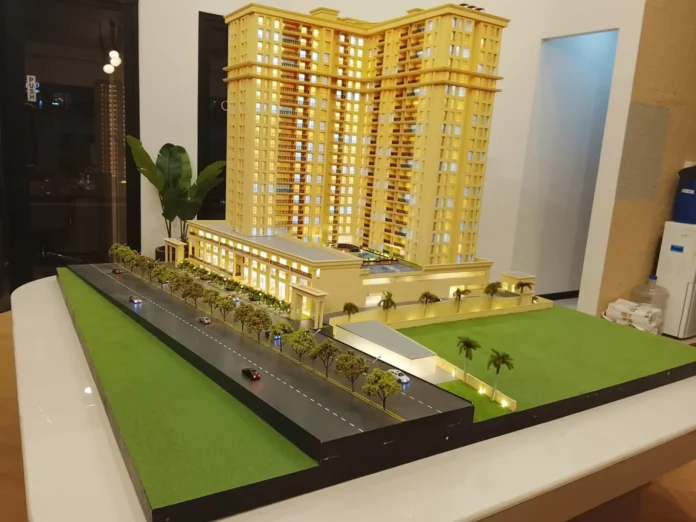


The Gap Between a Rendering and a Real Object
It’s easy to assume that with photorealistic rendering software and immersive walkthroughs, physical models have become a relic of an older era of architecture. Walk into any serious design studio or developer’s sales office, though, and you’ll usually still find one sitting somewhere prominent. That’s not nostalgia — it’s because a model does something renderings genuinely can’t replicate.
A screen shows you one view at a time, framed by someone else’s camera angle and lighting choices. A physical model lets a client walk around it, crouch down to see a sightline, or hold it up to check how two buildings relate to each other from an angle nobody thought to render. That kind of unscripted exploration builds a different, more trusting kind of understanding than watching a polished animation, however impressive the animation might be.
This is exactly why an architectural scale model remains a staple in client presentations, planning submissions, and investor pitches, even at firms that have fully embraced digital visualization for every other part of the design process.
Where Models Genuinely Add Value in the Design Process
Beyond client presentations, models play a real working role earlier in the design process too. Massing studies — simple block models showing the basic volumes of a proposed building against its neighbors — help architects and planners judge shadow patterns, streetscape impact, and scale in a way that’s harder to intuit from a plan view or even a 3D digital model on a screen.
Planning committees and local authorities, in many cases, still request or strongly favor physical models for significant developments, particularly for projects that will visibly change a streetscape or skyline. Seeing a proposed building’s scale relative to its surroundings, in three dimensions, tends to generate a more grounded discussion during public consultations than a rendering alone typically produces.
For competition submissions, a well-built model can also be the deciding factor between two similarly strong design proposals, simply because it demonstrates a level of commitment and clarity that a rendering package doesn’t convey in the same way. Jurors handling a physical object tend to spend more time with it than they do flipping through another set of printed boards.
What Makes a Model Actually Effective
Not every physical model achieves what it’s meant to, though. An architectural scale model that’s poorly proportioned, uses the wrong materials for the design intent, or skips important contextual elements like surrounding buildings and landscaping can actually undersell a good design rather than support it. The model needs to communicate the same design intent the architect had in mind, not just replicate the building’s shape at a smaller size.
Scale choice matters here more than clients often realize. A model built at too small a scale for the level of detail the design deserves ends up looking like a rough massing study rather than a finished presentation piece, while an unnecessarily large scale for a straightforward concept can make a modest project feel like it’s trying too hard. A studio experienced in architectural work will typically recommend scale based on the project’s purpose and complexity rather than defaulting to whatever’s convenient.
Context matters just as much as the building itself. Including neighboring structures, roads, and landscaping — even in simplified form — helps viewers understand how the design actually sits within its surroundings, which is often the exact question a planning committee or a prospective buyer is trying to answer.
Choosing the Right Studio for the Job
Because architectural models carry so much weight in high-stakes moments — planning approvals, investor decisions, competition results — it’s worth being selective about who builds one. Ask to see previous work involving similar building types and scales, and pay close attention to how accurately those models seem to represent the actual design intent rather than a generic interpretation of it.
A workshop that regularly collaborates with architects, rather than only taking finished drawings and working in isolation, tends to catch discrepancies and raise useful questions before they become expensive mistakes late in the build. That kind of collaborative relationship is usually what separates a model that genuinely supports the design story from one that merely looks impressive sitting on a table.
A Tool That Still Earns Its Place
Digital visualization tools will keep improving, and there’s no reason to expect that trend to reverse. What’s worth remembering is that a physical model isn’t competing with those tools so much as complementing them, offering a kind of tactile, unscripted understanding that a screen — however sophisticated — simply presents differently.
For architects and developers deciding whether to invest in a physical piece for an upcoming project, it’s worth thinking less about whether digital tools have made the format redundant and more about what specific job an architectural scale model would do in this particular presentation that the digital materials alone can’t quite achieve on their own.
Timing the Model Around the Design Process
One practical question that comes up often is when, exactly, to commission a model relative to the design timeline. Building one too early, before key design decisions are finalized, risks needing significant rework as the design evolves. Waiting too long, on the other hand, can mean the model isn’t ready in time for the presentation or planning submission it was meant to support.
Most experienced studios recommend starting the conversation once the design is roughly seventy to eighty percent settled — detailed enough that major changes are unlikely, but with enough lead time remaining to properly plan the build rather than rushing it. Getting this timing right is as much a part of a successful presentation piece as the craftsmanship itself.
A Format That Photographs Well Too
Beyond its role in live presentations, a well-built physical model also tends to photograph beautifully for press releases, award submissions, and marketing materials, giving a project a distinctive visual asset that a rendering alone doesn’t quite replicate in the same way. Photographers and journalists often gravitate toward a tangible model over a screen capture when covering a project launch.
This secondary benefit is easy to overlook when weighing the upfront cost of a model, but it’s worth factoring into the overall value calculation, particularly for high-profile projects likely to attract press attention or industry award consideration.