
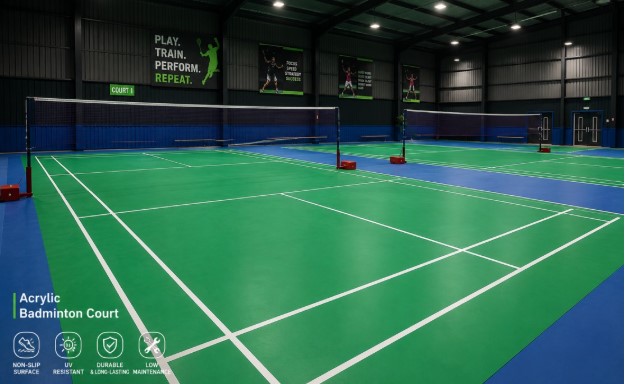


Badminton is one of the fastest racket sports in the world, requiring quick footwork, precise movement, and excellent player control. Whether you are constructing a professional sports facility, school court, sports academy, or community recreation center, choosing the Best Flooring for Badminton Courts is one of the most important decisions that impacts player performance, safety, and court longevity.
The right flooring not only enhances gameplay but also minimizes injuries, improves comfort, and reduces maintenance costs over time. This guide explores the Best material for Badminton Courts, court dimensions, construction requirements, and why synthetic badminton court systems have become the preferred choice for modern facilities.
Why Badminton Court Flooring Matters
Unlike many outdoor sports, badminton requires a smooth, non-slip, and shock-absorbing surface that supports rapid directional changes. Poor flooring can lead to injuries, uneven ball bounce, and increased maintenance expenses.
An ideal badminton court flooring system should offer:
- Excellent grip and traction
- Shock absorption for player comfort
- Consistent shuttle movement
- Durability under heavy usage
- Low maintenance requirements
- Long service life
Selecting the right flooring is therefore essential for achieving the Best Badminton Courts construction standards.
Official Badminton Court Dimensions
Before selecting flooring, it is important to understand standard badminton court dimensions.
Doubles Court Dimensions
- Length: 13.4 meters (44 feet)
- Width: 6.1 meters (20 feet)
Singles Court Dimensions
- Length: 13.4 meters (44 feet)
- Width: 5.18 meters (17 feet)
Additional Space Requirements
For safe play and movement:
- Minimum clearance around court: 1.5–2 meters
- Recommended ceiling height: 9–12 meters
- Adequate lighting without glare
Proper planning of badminton court dimensions ensures optimal performance and player safety.
Best Material for Badminton Courts
Several flooring options are available today. Each has its advantages and limitations.
1. Wooden Flooring
Wooden courts have traditionally been used in professional indoor badminton facilities.
Advantages
- Excellent shock absorption
- Premium appearance
- Comfortable playing experience
- Approved for high-level tournaments
Limitations
- High installation cost
- Regular maintenance required
- Vulnerable to moisture and humidity
- Expensive repairs
Wood flooring remains a premium option but may not be practical for every project.
2. PVC Vinyl Sports Flooring
PVC sports flooring is a popular choice for indoor badminton courts.
Advantages
- Good shock absorption
- Easy installation
- Available in multiple thicknesses
- Suitable for schools and clubs
Limitations
- Can wear over time
- Requires proper subfloor preparation
- Limited lifespan compared to advanced systems
PVC flooring offers a balance between affordability and performance.
3. Synthetic Acrylic Flooring
Today, many facility owners prefer synthetic badminton court systems because of their durability, versatility, and cost-effectiveness.
Advantages
- Excellent slip resistance
- Consistent playing surface
- UV-resistant and durable
- Low maintenance requirements
- Suitable for indoor and outdoor applications
- Long service life
Synthetic acrylic systems provide a professional sports surface capable of handling intensive use while maintaining performance characteristics.
For many sports facilities, synthetic acrylic flooring is considered among the Best Flooring for Badminton Courts due to its durability and overall value.
Why Synthetic Badminton Court Flooring Is Gaining Popularity
Modern sports infrastructure projects increasingly choose synthetic surfaces because they combine performance and affordability.
A typical synthetic badminton court system includes:
- Concrete or asphalt base
- Primer coat
- Acrylic resurfacer layer
- Cushion coating (optional)
- Color coating system
- Line marking
This layered structure creates a durable, attractive, and high-performance playing surface.
Key Benefits
Enhanced Player Safety
The textured surface provides excellent grip and reduces slipping risks during rapid movements.
Long-Term Durability
Synthetic acrylic courts can withstand heavy foot traffic and frequent usage without significant wear.
Weather Resistance
Outdoor synthetic badminton court systems perform well under varying weather conditions.
Cost Efficiency
Compared to wooden flooring, synthetic surfaces often deliver better long-term value through reduced maintenance costs.
Key Factors When Selecting Badminton Court Flooring
When evaluating the Best material for Badminton Courts, consider the following:
Usage Frequency
Professional academies and sports complexes require higher-performance surfaces than recreational facilities.
Indoor vs Outdoor Installation
Indoor courts may use wood or PVC, while outdoor courts typically benefit from synthetic acrylic systems.
Budget
Initial construction costs should be balanced against long-term maintenance expenses.
Maintenance Requirements
Choose a flooring system that aligns with your facility’s maintenance capabilities and operational budget.
Player Safety
Shock absorption, traction, and surface consistency should always be top priorities.
Best Badminton Courts Construction Process
Achieving a professional-quality badminton facility involves more than selecting flooring.
Step 1: Site Preparation
The area must be properly graded and prepared.
Step 2: Base Construction
A strong concrete or asphalt base ensures long-term structural stability.
Step 3: Surface Preparation
The base is cleaned, repaired, and leveled before coating application.
Step 4: Flooring Installation
The selected flooring system is installed according to manufacturer specifications.
Step 5: Court Marking
Official badminton court dimensions and line markings are applied.
Step 6: Quality Inspection
The completed court is checked for surface consistency, slope, and playing performance.
Following these steps ensures the Best Badminton Courts construction results and maximizes court lifespan.
Maintenance Tips for Long-Lasting Performance
To preserve court quality:
- Clean the surface regularly
- Remove dust and debris
- Repair cracks promptly
- Recoat surfaces when necessary
- Inspect line markings periodically
- Avoid dragging heavy equipment across the court
Routine maintenance significantly extends the life of badminton court flooring.
Conclusion
Selecting the Best Flooring for Badminton Courts requires careful evaluation of performance, durability, safety, and budget. While wooden and PVC flooring remain viable options, modern synthetic badminton court systems have emerged as one of the most practical solutions for sports academies, schools, clubs, and recreational facilities.
By understanding official badminton court dimensions, choosing the Best material for Badminton Courts, and following proper Best Badminton Courts construction practices, facility owners can create a high-quality court that delivers exceptional playing experiences for years to come.
Investing in the right flooring today ensures better performance, greater player safety, and long-term value for any badminton facility.